
Day 1 GNAM Week
Master of Management Faculty of Economics and Business Universitas
Indonesia, March 2025
The first day of Global Network Week March 2025 began with anticipation and enthusiasm as hundreds of participants from more than 15 countries gathered in the auditorium. Before the formal opening, an ice-breaking session was held to energize the participants and foster interaction. A lively Kahoot game was introduced, allowing attendees to test their knowledge in a fun and engaging way. At the end of the session, the top three performers were rewarded with prizes. This activity successfully set a positive tone for the agendas ahead.
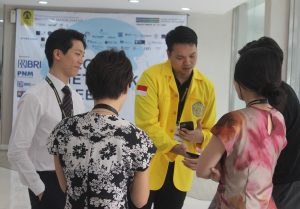
With spirits high, the Master of Ceremonies (MC) took the stage, extending a warm welcome to the distinguished speakers, faculty members, and students who had gathered for this prestigious event. The atmosphere was further elevated as the Indonesian national anthem, “Indonesia Raya,” was played. Following the opening ceremony, Arief Wibisono Lubis, Ph.D.,Vice Dean of Universitas Indonesia’s Faculty of Economics and Business gave the welcoming speech and so GN Week was officially inaugurated.
Distinguished speakers took turns expounding on aspects of the overarching topic within their respective areas of expertise and deftly addressing questions from the participants, demonstrating the significance of this global event in fostering discussions on critical issues.
Session 1
Bridging Poverty and Climate Action: The Role of Business in Achieving a Just Transition to Net Zero
Delivered by Mr. Budiman Sudjatmiko
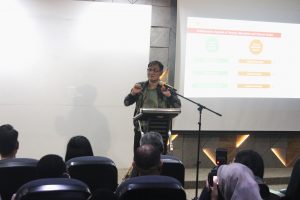
The speaker for the first session of GNAM Global Network Week Day 1 was Mr. Budiman Sudjatmiko, Head of the Agency for Accelerating Poverty Alleviation (BP Taskin). His session, titled “Bridging Poverty and Climate Action: The Role of Business in Achieving a Just Transition to Net Zero,” highlighted the crucial relationship between economic development, poverty alleviation, and environmental sustainability.
At the heart of the discussion was the collaboration agenda between poverty alleviation and climate action, emphasizing that a just transition to net zero must not leave the most vulnerable communities, Budiman underscored the need to close the gap between producers and consumers, whether socially or geographically. A more efficient, environmentally-friendly, and sustainable economic system can only be achieved when economic resources and opportunities are equitably distributed.
He outlined the pressing challenges we face today, including rising carbon consumption, the decreasing natural carrying capacity, and inefficiencies in production processes. In response to these challenges, he pointed to technological advancements as key solutions. Democratization through 3D printing, automation of energy sources, and precision supply-demand management supported by big data were presented as innovations that could help build a more inclusive and sustainable economy. However, he posed a crucial question to the audience: How do we democratize access to these technologies?
To address the challenges of inequality in the transition to sustainability, Budiman introduced a new framework for economic and social rights in the era of sustainability and digital transformation: the 8 Fundamental Rights. These rights define the essential resources and infrastructures that must be equitably distributed to ensure that economic and technological advancements serve everyone—not just a privileged few. The framework is divided into Vertical Rights, which encompass critical foundational elements necessary for individual and community empowerment, and Horizontal Rights, which define how assets—both private and shared—should be managed to promote fairness and inclusivity.
Vertical Rights focus on securing access to fundamental resources: Spaces, which include land, infrastructure, and sustainable living environments; Natural Resources, ensuring the fair use of water, minerals, forests, and clean air to maintain both economic and ecological balance; and Infrastructure, such as roads, energy grids, and digital networks that connect communities to economic opportunities. Economic empowerment is further supported by Capital, promoting financial inclusion so all individuals can participate in and benefit from the economy, and Data, advocating for open and fair access to digital information to drive innovation and informed decision-making. Additionally, Know-How emphasizes education and skills development to equip individuals for technological and economic changes, while Communities focus on strengthening social structures that foster collective action. Finally, Power ensures political and economic representation, amplifying the voices of marginalized groups in decision-making processes.
Complementing these foundational rights, Horizontal Rights define how assets are distributed and governed. Private Assets protect individual ownership and control over personal and business resources, while Public Assets ensure that government-managed resources are transparently governed and equitably distributed. Lastly, Open Assets safeguard shared commons—such as knowledge, digital platforms, and environmental resources—so they remain accessible to all, preventing monopolization and ensuring widespread benefits.
Through this framework, Budiman emphasized the need for an inclusive approach to economic development, where sustainability is not merely an environmental goal but a fundamental human right. By securing access to these essential resources and assets, societies can ensure that no one is left behind in the transition to a green and equitable future.
The ultimate goal, he explained, is to create self-sufficient communities where people are not merely passive participants in the economy but active contributors who can leverage sustainable technologies for their well-being. He also challenged the conventional notion that GDP is the sole measure of a country’s economic progress. Instead, he advocated for a broader framework that includes equality, the happiness index, and an ecological-centered society as more accurate indicators of true prosperity.
Budiman concluded his talk by that climate action cannot be separated from social justice. An eco-friendly transition can only be achieved through greater equality and poverty alleviation, ensuring that sustainability is not just a privilege of the wealthy but a right accessible to all. His session left participants reflecting on the need for businesses, governments, and communities to work together in creating an inclusive, climate-resilient future.
Session 2
Towards a Sustainable and Ethical Energy Supply Chain for Indonesian SMEs
Delivered by Mr. Luky Yusgiantoro (Executive Secretary of SKK Migas)
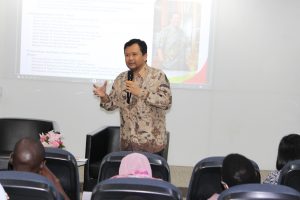
by introducing SKK Migas. SKK Migas emphasizes the importance of developing a responsible energy supply chain that aligns with sustainability principles and ethical business practices. Indonesian SMEs play a crucial role in the national economy and so integrating them into a sustainable energy ecosystem can enhance their competitiveness while reducing environmental impact. SKK Migas highlights the need for ethical sourcing, responsible production, and transparent supply chain management to ensure long-term energy security. Additionally, adopting sustainable practices, such as using renewable energy sources and implementing efficient resource management, can help SMEs comply with global environmental standards and attract investment opportunities. This approach not only benefits businesses but also supports Indonesia’s commitment to achieving energy sustainability and reducing carbon emissions.
SKK Migas is responsible for oil and gas production in Indonesia, playing a crucial role in ensuring the country’s energy supply. However, while their primary focus is maximizing production, they also recognize the negative environmental and social impacts associated with oil and gas extraction. These include carbon emissions, deforestation, water contamination, and the displacement of local communities. As a result, SKK Migas has been working on balancing energy security with sustainability efforts, ensuring that oil and gas production aligns with ethical and environmental standards. Despite the growing global shift towards renewable energy, oil and gas remain vital for Indonesia’s economy and energy needs. The country still relies heavily on fossil fuels to power industries, transportation, and households. Given this dependency, SKK Migas must maintain stable production levels while exploring ways to minimize environmental harm and support energy transition efforts.
One of the key performance indicators (KPIs) for SKK Migas is production volume, which reflects the total amount of oil and gas extracted. Meeting or exceeding production targets is critical for ensuring national energy security, generating revenue, and attracting investments. However, as the global energy landscape evolves, SKK Migas must also focus on operational efficiency, environmental responsibility, and long-term sustainability strategies. This includes initiatives such as carbon capture technology, improved energy efficiency, and collaboration with renewable energy sectors to create a more resilient and ethical energy supply chain for Indonesia.
that Indonesia’s investor attractiveness ranks 9 out of 14 countries. is good news because it indicates that Indonesia remains a competitive destination for investment despite the challenges in the global and domestic economic landscape. While the ranking suggests there is room for improvement, being in the top 10 among comparable markets reflects investor confidence in Indonesia’s economic potential, regulatory environment, and business opportunities.
Indonesia’s national strategic projects are increasingly dominated by the Development Gas Project, reflecting the country’s emphasis on natural gas as a key energy source. While Indonesia has long relied on oil and gas production, gas is seen as distinct from oil in its potential for long-term sustainability. Gas production has been steadily increasing, largely driven by ongoing discoveries in new gas fields across the country. This growth highlights the huge opportunity that natural gas production represents for Indonesia’s energy future. However, the complexity of natural gas, especially its composition, presents challenges in extraction and production processes. Unlike oil, which is relatively straightforward to produce, natural gas requires specialized handling and technology to manage its different forms and varying levels of purity. Despite these challenges, the increasing production of natural gas opens new opportunities for the country, especially as the global energy landscape shifts toward cleaner alternatives.
SKK Migas has established regarding natural gas production to ensure energy sustainability in Indonesia. These targets are part of a broader effort to secure energy resources for the long term while addressing growing demand for cleaner energy solutions. The development of gas fields, coupled with strategic investments in production and infrastructure, will help Indonesia reduce its reliance on oil and ensure a more diversified and resilient energy portfolio. In line with these efforts, oil and gas are part of Indonesia’s ASTACITA program, an initiative introduced by the President. The program aims to strengthen the management, regulation, and development of the country’s energy resources. By incorporating oil and gas into this broader framework, the government is working to ensure that energy production remains stable and sustainable, in line with Indonesia’s long-term energy goals and environmental commitments.
Session 3
The Role of Social Media in Raising Awareness and Driving Action
Delivered by Dr. Sonny Sudarjanto
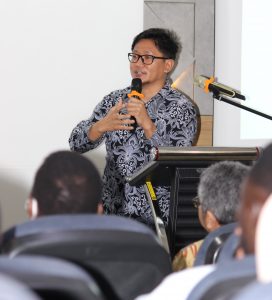
Dr. Sonny Sudarjanto’s talk on The Role of Social Media in Raising Awareness and Driving Action explored Indonesia’s digital transformation journey and its efforts to foster economic growth through technology and innovation. His presentation highlighted Indonesia’s ambitious initiatives to strengthen digital infrastructure, build digital talent, and expand the startup ecosystem, with social media playing a pivotal role in these developments.
Indonesia, as the fourth most populous country and Southeast Asia’s largest digital economy, has made significant investments in digital infrastructure to improve connectivity across its vast archipelago. With fiber optic cables stretching the equivalent of nine times the Earth’s circumference, 4G coverage in over 70,000 villages, and high-throughput satellites for remote areas, Indonesia has created a strong foundation for digital growth. This enhanced connectivity has enabled social media to thrive, transforming how information is shared and businesses operate.
Social media has been instrumental in raising awareness about e-commerce, especially in a country where digital transactions were initially met with skepticism. The shift toward digital payments, driven by platforms like GoPay, helped accelerate e-commerce adoption and build consumer trust. This cultural change has been key to Indonesia’s emergence as a digital economy powerhouse, with startups leveraging social media to reach customers, build brand credibility, and promote digital services.
Dr. Sonny highlighted Indonesia’s thriving startup ecosystem, which has benefited from structured programs designed to guide entrepreneurs from ideation to market success. Programs such as the 1000 Startups Initiative help young innovators develop their ideas into viable products, while Startup Studio supports early-stage companies in refining their product-market fit. Additionally, Hub.ID connects post-seed startups with investors and corporate partners to scale their businesses globally. These programs collectively empower Indonesian startups to navigate common challenges, such as securing funding and understanding market dynamics.
Social media has also played a key role in Indonesia’s green technology initiatives. Programs like ConnectED and collaborations with organizations such as GIZ focus on fostering startups in the climate, agriculture, and sustainability sectors. These initiatives leverage social media to amplify their message, connect with investors, and raise awareness about sustainable practices.
In conclusion, Dr. Sonny’s presentation emphasized that Indonesia’s rapid digital transformation has been driven by robust infrastructure investments, strategic talent development, and proactive startup support. Social media has served as a crucial catalyst in promoting digital adoption, fostering entrepreneurial growth, and driving social change. By leveraging digital platforms effectively, Indonesia is well-positioned to harness the potential of its digital economy and achieve its vision of becoming a global innovator by 2045.
Session 4
Sustainable Business Practices: Case of DuAnyam (craft business)
Delivered by Hanna Keraf
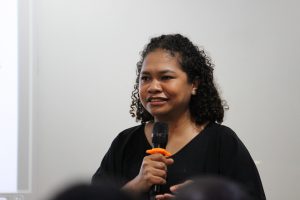
Hanna Keraf founder and of DuAnyam, a leading retailer collaborates with corporate and retail partners to provide eco-friendly, handwoven products made by women in Nusa Tenggara from leaves. Established in Flores, DuAnyam has been operational for 11 years, focusing on leveraging local resources and providing technical assistance and supply chain systems to empower women in rural villages.
The MC invited the speaker to the front, and the moderator greeted the participants by asking about their country of origin. The speaker began the session by introducing as a socio-preneur in Indonesia. DuAnyam has been operating for 10 years, and this year marks the 11th year. The company works with more than 1,200 artisans and currently collaborates with one of the biggest retailer companies in the world. Initially established in NTT (East Nusa Tenggara), DuAnyam was founded with the goal of empowering housewives to earn an income. Indonesia’s status as an archipelagic country makes shipping costs expensive, but the region also possesses inherited skills and local wisdom. These factors led to the birth of DuAnyam.
The initial focus was on supply chain management (SCM) by building a system involving product designers, engineers, and universities for R&D. They sourced raw material suppliers who support women and developed a database for leaf suppliers. To appeal to the global market, they incorporated storytelling into their products. Many of their women workers are regularly paid in cash due to limited access to mobile phones, making DuAnyam a bridge to financial access. Each cluster of three villages has one quality control (QC) center that conducts final QC before shipping.
Operations include providing different training sessions based on the needs of each village to improve productivity. The only way to empower women in these areas is by offering flexible work opportunities due to cultural challenges. Besides economic impact, DuAnyam has contributed to improving education and local nutrition. They have formed partnerships with various entities, including the government, corporations, and hotels. A significant behavioral change has been observed—women have become more confident in making decisions and participating in village leadership, bringing both business and social impact.
The production process includes raw material collection, sun-drying, cutting based on product demand, applying environmentally friendly preservation (especially for global markets), administrative documentation, weaving, quality control, and final product delivery. DuAnyam produces two types of products: home decor for export and daily-use products like bags and lanyards for the local market. As an SME, DuAnyam focuses on inclusive employment but faces challenges such as resource quality and a lack of support systems.
DuAnyam’s mission is to economically empower and improve the livelihood of women in rural Indonesia. The company produces corporate souvenirs, hotel amenities, and home decor collections that are available in local and international markets. To date, DuAnyam has empowered over 1,600 women artisans in more than 54 villages located in East Nusa Tenggara, South Kalimantan, and Papua. The company operates on three main pillars: Empower Women, Promote Culture, and Improve Livelihood.
The company has created a database to ensure consistent communication and production standards among weavers. DuAnyam also offers regular payment systems and social welfare programs, including educational scholarships and food provisions, to maintain weaver loyalty. Their social programs include a Malnutrition Prevention Program, which distributes healthy food packages and conducts educational sessions on nutrition, and an Education Initiative that provides scholarships and workshops to enhance skills and social mobility. Additionally, DuAnyam integrates women weavers into their business model, providing stable income opportunities and promoting traditional crafts and weaving techniques.